
AI and MCP Make The EDI Support Burden Vanish

Adrian Duyzer
I come across a lot of articles about how AI will change EDI. Few, if any, describe the changes that are already here.
This is probably because most people are using technologies that haven’t caught up. Other than ECGrid, Tediware is the only general-purpose EDI platform to ship an MCP server for agent integration.
So it makes sense that people are still talking hypotheticals. But I can show you what an AI-native EDI platform is like to use, today. If you’re not using Tediware, these are sneak peeks into the future.
This post focuses on support, and you’ll see how Tediware saves time and - most importantly - reduces friction between trading partners.
One reason EDI support is a major pain is that it’s asynchronous. Determining what has gone wrong requires tracing data across multiple exchanges and transaction sets.
I got an email from a carrier’s dispatch team, asking me why three shipments they’d already delivered were canceled in their TMS. I checked one of them and they had indeed received a cancellation for the load from the shipper. Why?
The traditional approach is to pull every 204, 990, 997 and 214 that got exchanged, line up the control numbers and timestamps, and start digging. For three shipments that were handled over a month, that’s dozens of documents.
Faced with that tedious prospect, most people file a ticket with the trading partner. Unfortunately, their support team is also too overburdened to spend hours on it. Little wonder that people constantly complain they wait days or weeks for ticket resolution.
Here’s what I did instead: I pasted the email into Claude Code, which was connected to Tediware’s MCP server, and asked what happened.
It read the history for each shipment and reported back:
- The cancellations were real
- Before each cancellation, the shipper had sent an updated 204 (change tender) for the same load, with a deadline to respond
- Nobody had sent a 990 for any of those updated 204s
- Each cancellation arrived within a minute of the deadline passing on an unanswered updated 204
- Updates kept arriving after the loads were delivered, so even completed loads were being canceled
It seemed that the shipper’s system treats an unanswered 204 as a declined load, even if an earlier version was accepted. When the deadline passes without a 990, it cancels the shipment.
Given that this was time-sensitive (multiple loads in transit), I provided immediate operational guidance to the carrier: always promptly send a 990 for inbound 204s, even if they’re for a shipment that has already been delivered. I was also able to loop in their tech person, describe what I thought was happening, and propose they adjust their TMS to automatically accept updates (and send the 990) for any shipment that had previously been accepted.
Then I had Claude draft an email to the shipper with all the relevant information, along with an archive of all the relevant EDI files that were exchanged - a total of 82 documents - to the effect of, is this how your system works? It included a breakdown of the timeline for one of the tenders, with timestamped data for every exchange.
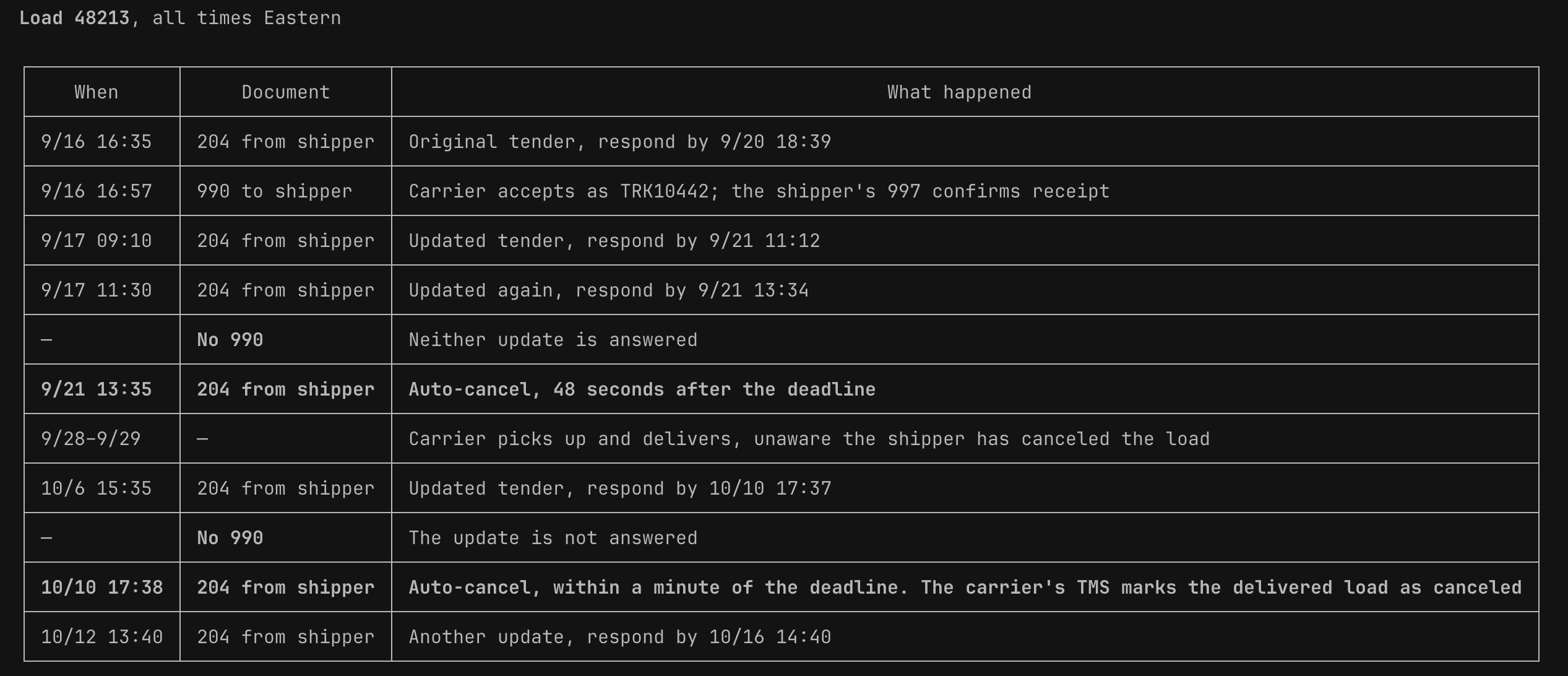
I sent this to the shipper’s EDI manager, who quickly confirmed that this was the root issue. Given I’d already provided updated operational guidelines to the carrier’s team, we agreed that we’d pause on any technical updates and observe operations going forward to see if that was sufficient to resolve the issue.
Altogether, this took about ten minutes. Handling this issue quickly is one benefit, but there’s a larger one. Carriers work hard to keep their shippers happy. They want to avoid friction in the trading partnership, which is exactly what a vaguely worded complaint to a busy EDI support team creates. That friction is hugely reduced when support requests take the form of a professionally worded email with clear details, a complete timeline of all document exchange, and 82 attached documents.
Read about using coding agents for EDI or check out our MCP server for EDI documentation.